LCA and Binary Lifting
How to jump up a tree in powers of two — kth ancestors, lowest common ancestors, and path distances, all in O(log n) per query.
Table of contents
if you solve enough tree problems you keep running into the same two questions — “what is the kth ancestor of this node?” and “where do the paths from u and v meet?”. both get answered by the same trick: binary lifting. this post builds it from scratch, ending with the exact template I use in contests.
What is the LCA?
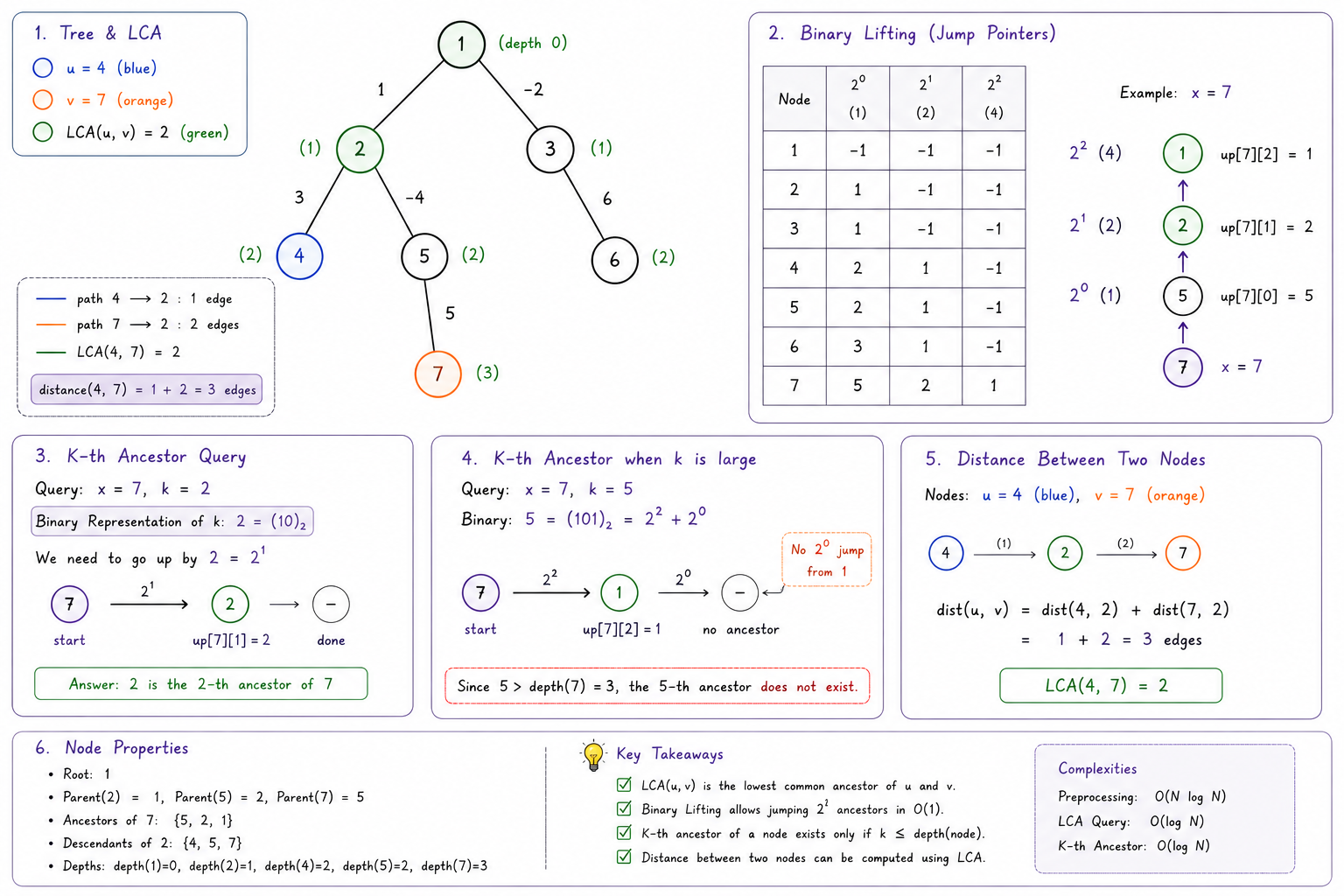
take a rooted tree. the lowest common ancestor (LCA) of two nodes u and v is the deepest node that is an ancestor of both. if you walk from u up to the root and from v up to the root, the two walks eventually merge — the LCA is the first node where they merge.
a couple of quick facts:
- if
uis an ancestor ofv, thenlca(u, v) = u lca(u, u) = u- the path from
utovalways goesu → lca → v, which is why so many path queries reduce to an lca query
The naive way
to find lca(u, v) by hand you would do this:
- whichever node is deeper, walk it up one parent at a time until both are at the same depth
- now move both up together, one step at a time, until they land on the same node
that’s correct, but it’s O(n) per query — on a long chain the walk can cross the whole tree. with 10^5 queries on a tree of 10^5 nodes that’s 10^10 steps. too slow. we need to walk up the tree faster than one step at a time.
The core idea
here’s the trick: every number has a binary representation.
13 = 8 + 4 + 1 = 2^3 + 2^2 + 2^0so jumping 13 steps up doesn’t have to be 13 single steps — it can be one jump of 8, one jump of 4, one jump of 1. if we precompute, for every node, its 1st, 2nd, 4th, 8th, … ancestors, then any jump of size k becomes at most log(k) jumps. that’s the whole “binary lifting” idea — we lift through the tree in powers of two.
so we build a table:
up[i][j] = the 2^i-th ancestor of node jup[0][j] is just the parent of j, which a single dfs gives us (along with depth[j]). every higher row comes from a really clean recurrence:
up[i][j] = up[i-1][ up[i-1][j] ]in words — to jump 2^i steps, jump 2^(i-1) steps, then jump 2^(i-1) steps again from where you landed. the table has log(n) rows of n entries, so preprocessing is O(n log n) time and space.
Kth ancestor
once the table exists, the kth ancestor is exactly the binary decomposition idea:
int kthAnc (int u, int k) {
    if (k > depth[u])
        return -1;

    for (int i = 0; i < lg; i++)
        if (k >> i & 1)
            u = up[i][u];

    return u;
}
look at each set bit of k and take that jump. for k = 13 we jump 2^0, then 2^2, then 2^3. order doesn’t matter — the ancestors compose either way. O(log k) per query.
The LCA query
now the main event. finding lca(u, v) is the naive algorithm again, just with big jumps:
step 1 — equalize depths. assume u is the deeper one (swap otherwise). we need to lift u by exactly depth[u] - depth[v] steps. instead of computing the difference and decomposing it, the loop below does the same thing greedily — take any power-of-two jump that doesn’t overshoot v’s depth:
for (int i = lg - 1; i >= 0; i--)
    if (depth[u] - (1 << i) >= depth[v])
        u = up[i][u];
step 2 — early exit. if u == v now, then v was an ancestor of u all along, and the answer is v itself.
step 3 — lift both together. this is the clever part. we go from the biggest jump down to the smallest, and take a jump only if it keeps u and v different:
for (int i = lg - 1; i >= 0; i--)
    if (up[i][u] != up[i][v]) {
        u = up[i][u];
        v = up[i][v];
    }

return up[0][u];
why “only if they stay different”? because if up[i][u] == up[i][v], that node is a common ancestor — but maybe not the lowest one. we might have jumped past the lca. by refusing every jump that makes them equal, both nodes converge to just below the lca — they end up as two different children of it. one final parent step (up[0][u]) gives the answer.
it’s the same idea as binary searching for the boundary: instead of looking for the first place they’re equal, we push as far as possible while they’re still different.
each step is at most log(n) jumps, so a query is O(log n).
Distance between two nodes
this one falls out for free, and honestly it’s the form I use most often:
dist(u, v) = depth[u] + depth[v] - 2 * depth[lca(u, v)]depth counts edges from the root. going u → lca takes depth[u] - depth[lca] edges, going lca → v takes depth[v] - depth[lca], add them up.
Complexity
- Preprocessing: O(n log n) time and space — one dfs plus filling the table
- Per query: O(log n) for
lca,dist, andkthAnc
one note — cp-algorithms presents a slightly different version that stores euler tour entry/exit times (tin/tout) and uses them for O(1) “is u an ancestor of v” checks instead of depths. both versions are equivalent in complexity; I find the depth-based one easier to remember since the depth array is useful on its own (it gives you dist for free).
I used this exact template recently in 3559. Number of Ways to Assign Edge Weights II — the whole problem collapses to dist(u, v) once you see the counting argument.
Full Template
BinaryLift — full copy-paste template
#include <bits/stdc++.h>
using namespace std;

struct BinaryLift {
    int n, lg;
    vector<int> depth;
    vector<vector<int>> adj, up;

    BinaryLift(int _n)
        : n(_n), lg(__lg(n - 1) + 1),
          depth(n), adj(n),
          up(lg, vector<int>(n, 0)) {}

    void addEdge(int u, int v) {
        adj[u].push_back(v);
        adj[v].push_back(u);
    }

    void init(int r = -1) {
        if (r == -1) {
            for (int u = 0; u < n; u++)
                if (up[0][u] == -1) dfs(u);
        } else {
            dfs(r);
        }
        for (int i = 1; i < lg; i++)
            for (int j = 0; j < n; j++)
                if (up[i - 1][j] != -1)
                    up[i][j] = up[i - 1][up[i - 1][j]];
    }

    void dfs(int u) {
        for (int v : adj[u])
            if (v != up[0][u]) {
                depth[v] = depth[u] + 1;
                up[0][v] = u;
                dfs(v);
            }
    }

    // lowest common ancestor
    int lca(int u, int v) {
        if (depth[u] < depth[v]) swap(u, v);
        for (int i = lg - 1; i >= 0; i--)
            if (depth[u] - (1 << i) >= depth[v])
                u = up[i][u];
        if (u == v) return u;
        for (int i = lg - 1; i >= 0; i--)
            if (up[i][u] != up[i][v]) {
                u = up[i][u];
                v = up[i][v];
            }
        return up[0][u];
    }

    // number of edges on the path u..v
    int dist(int u, int v) {
        return depth[u] + depth[v] - 2 * depth[lca(u, v)];
    }

    // k-th ancestor of u, or -1 if it doesn't exist
    int kthAnc(int u, int k) {
        if (k > depth[u]) return -1;
        for (int i = 0; i < lg; i++)
            if (k >> i & 1) u = up[i][u];
        return u;
    }
};

// --- usage ---
// BinaryLift g(n + 1);          // 1-indexed, size n+1
// for (auto& e : edges)
//     g.addEdge(e[0], e[1]);
// g.init(1);                    // root = 1
//
// g.lca(u, v)
// g.dist(u, v)
// g.kthAnc(u, k)
BinaryLift with path sum — weighted edges
#include <bits/stdc++.h>
using namespace std;

struct BinaryLift {
    int n, lg;
    vector<int> depth;
    vector<vector<pair<int,int>>> adj;
    vector<vector<int>> up;
    vector<vector<long long>> sum;

    BinaryLift(int n) : n(n), lg(__lg(n) + 1),
        depth(n, 0), adj(n),
        up(lg, vector<int>(n, -1)),
        sum(lg, vector<long long>(n, 0)) {}

    void addEdge(int u, int v, int w) {
        adj[u].push_back({v, w});
        adj[v].push_back({u, w});
    }

    void dfs(int u, int p, int w) {
        up[0][u] = p;
        sum[0][u] = w;
        for (auto [v, wt] : adj[u]) {
            if (v == p) continue;
            depth[v] = depth[u] + 1;
            dfs(v, u, wt);
        }
    }

    void init(int root = 0) {
        dfs(root, -1, 0);
        for (int i = 1; i < lg; i++)
            for (int v = 0; v < n; v++) {
                int mid = up[i-1][v];
                if (mid == -1) continue;
                up[i][v] = up[i-1][mid];
                sum[i][v] = sum[i-1][v] + sum[i-1][mid];
            }
    }

    int lca(int u, int v) {
        if (depth[u] < depth[v]) swap(u, v);
        int diff = depth[u] - depth[v];
        for (int i = 0; i < lg; i++)
            if (diff >> i & 1) u = up[i][u];
        if (u == v) return u;
        for (int i = lg - 1; i >= 0; i--)
            if (up[i][u] != up[i][v]) {
                u = up[i][u];
                v = up[i][v];
            }
        return up[0][u];
    }

    // sum of edge weights climbing k steps from u
    long long liftSum(int u, int k) {
        long long res = 0;
        for (int i = 0; i < lg; i++)
            if (k >> i & 1) { res += sum[i][u]; u = up[i][u]; }
        return res;
    }

    // total weight on path u..v
    long long pathSum(int u, int v) {
        int L = lca(u, v);
        return liftSum(u, depth[u] - depth[L])
             + liftSum(v, depth[v] - depth[L]);
    }

    int dist(int u, int v) {
        return depth[u] + depth[v] - 2 * depth[lca(u, v)];
    }

    int kthAncestor(int u, int k) {
        for (int i = 0; i < lg; i++)
            if (k >> i & 1) u = up[i][u];
        return u;
    }
};

// --- usage ---
// BinaryLift g(n);
// g.addEdge(u, v, w);
// g.init(0);               // root = 0
//
// g.lca(u, v)
// g.pathSum(u, v)          // sum of weights on u..v
// g.dist(u, v)             // number of edges on u..v
// g.kthAncestor(u, k)